AI Disclosure: This blog post was written with the help of Claude Code. Here is the prompt that drove it:
Prompt: “Write a new blog post: Managing Transitions - Fear, Uncertainty and Doubt. In the context of ASEO. Change leads to uncertainty, which leads to fear, which leads to resistance. People who resist the AI transformation either honestly believe it is bad and does not work, or they are afraid that the new jobs are jobs they either do not want to do or even worse cannot do. Change is uncomfortable. People who are comfortable feeling uncomfortable will thrive. AI-Adoption at an organisational level is not necessarily a technical problem, but more a communication challenge. You need to be able to articulate how the place you are going to looks like and why/how this is a good place for everybody involved. You know you have succeeded when the employees can see themselves in this new picture.”
Note: The blog post was polished and hardened by hand.
I had a conversation recently with a CTO. Smart person. Running an engineering organization of about 80 people. Genuinely committed to the AI transformation.
And yet — six months in, the org was not necessarily transitioning as fast as it should be. Individual engineers were using AI tools. Some were excited. A lot were … not. Adoption was patchy. Morale was a mixed bag of excitment, fear and skepticism.
Question is: The tools are there. The support is there. This (the transition to an AI-enabled Software-Engineering Organisation (ASEO)) should be a no-brainer/easy. Why is it so hard?
I think I know why. And it has nothing to do with technology. All transitions are hard.
FUD is not a bug. It is a feature
In the 90s FUD — Fear, Uncertainty, Doubt — was used by Microsoft to slow down the migration/transition of customers to Linux. Reality is FUD plays a role in any transition that I have managed in the last 30 years. Not because somebody is actively steering it up, but because everybody is feeling it naturally.
Change leads to uncertainty. Uncertainty leads to fear. Fear leads to doubt and resistance. This is not a character flaw. This is a nervous system doing exactly what it is supposed to do. When the ground shifts, you grip harder. When the future is unclear, you defend the present.
Sometimes we as CTOs treat this as a problem to be solved with more information. Another all-hands. Another deck. Another LinkedIn post about the AI transformation. More signal into a system that is already overwhelmed with uncertainty.
Two kinds of resistance
When people push back on the AI transformation (or any transformation for that matter), they are usually doing one of two things: Honest Skepticism vs. Fear of Irrelevance.
The first is honest skepticism. These are the engineers who have actually looked at the evidence and concluded that the AI transformation is oversold, harmful, or both. They have seen the comprehension debt accumulate. They have reviewed the AI-generated PRs and quietly fixed the subtle bugs nobody else caught. They are not afraid. They are unconvinced.

This is an opportunity for productive friction. Either they can convince you or you can convince them. In any case at the end the world is going to be a better place.
The second is fear of irrelevance. These are the engineers who are not sure whether the new jobs are jobs they want to do, or even jobs they can do. They have built careers around certain skills. The ASEO asks them to shift upstream — from writing code to shaping problems (and solutions), from execution to judgment. That is not a small ask. And the honest truth is that some people will find this shift energizing, and some will find it genuinely threatening (because they are afraid that they will find out that they are either not willing or not able to make the shift).
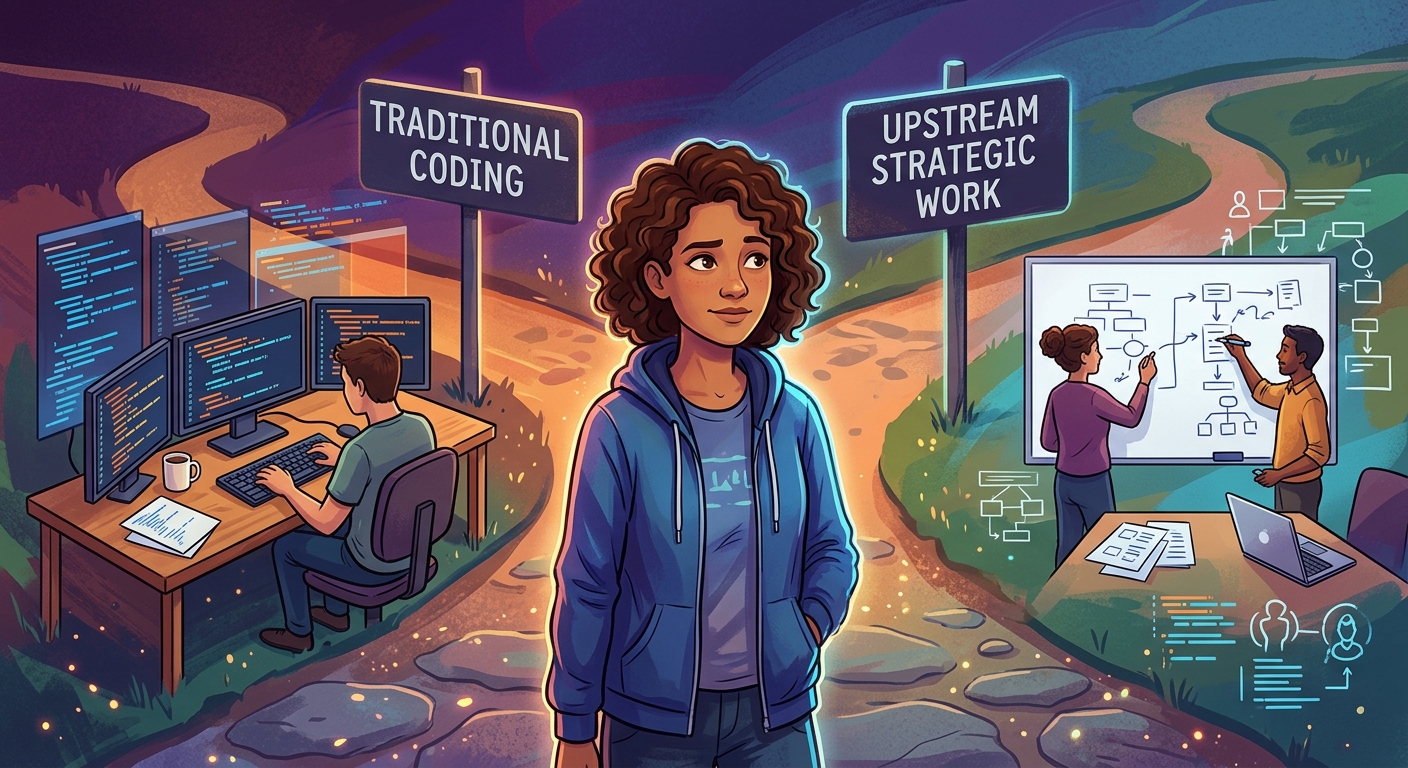
Both groups need something from you. But they need different things.
Comfortable feeling uncomfortable
The (very) best engineers/human beings that thrive in transitions and situations like this share a trait: they are comfortable feeling uncomfortable. They have a growth-mindset. Not fearless — that is not the point. They feel the discomfort and move anyway. They are willing to not know, to be a beginner again, to ask questions that expose the edges of their current knowledge.
This is not something you can train in a workshop. But you can create the conditions for it. You can model it yourself. You can reward it explicitly. You can build a culture where not knowing is the starting point, not a failure state. You need to create a safe space for the transition to take place.
The people who will struggle are the ones who have optimized hard for certainty — who have built their professional identity around being the person who knows. The AI transformation asks them to un-know a lot of what they know. That is genuinely hard.
The communication problem that needs solving
Here is what I keep coming back to. The AI transformation at an organizational level is not primarily a technical problem. The tools exist. The models exist. The ROI case, for many scenarios, exists.
The bottleneck is communication.
Specifically: most of us can articulate where the organization is right now, and they can articulate the destination in the abstract (“we will be more productive”, “we will ship faster”). What we don’t do enough (sometimes) is paint a picture of what the destination actually looks and feels like for the people making the journey.
What does a day in the life of a senior engineer look like in the ASEO? What does an interesting problem look like when the boilerplate is handled? What new skills become valuable? What old anxieties go away?
A rough sketch: engineers in the ASEO spend less time on execution drudgery and more time on the work that actually requires human judgment — understanding user needs, shaping the problem before the solution, catching the things the model gets subtly wrong. The interesting problems do not go away. They become more accessible. The craft does not disappear. It moves upstream.
You know you have succeeded with the communication when your engineers can figure out for themselves where they fit in the new picture — what role they want to play, what new thing they want to become good at — and are genuinely excited about it. Not because you told them to be. Because they can see it.
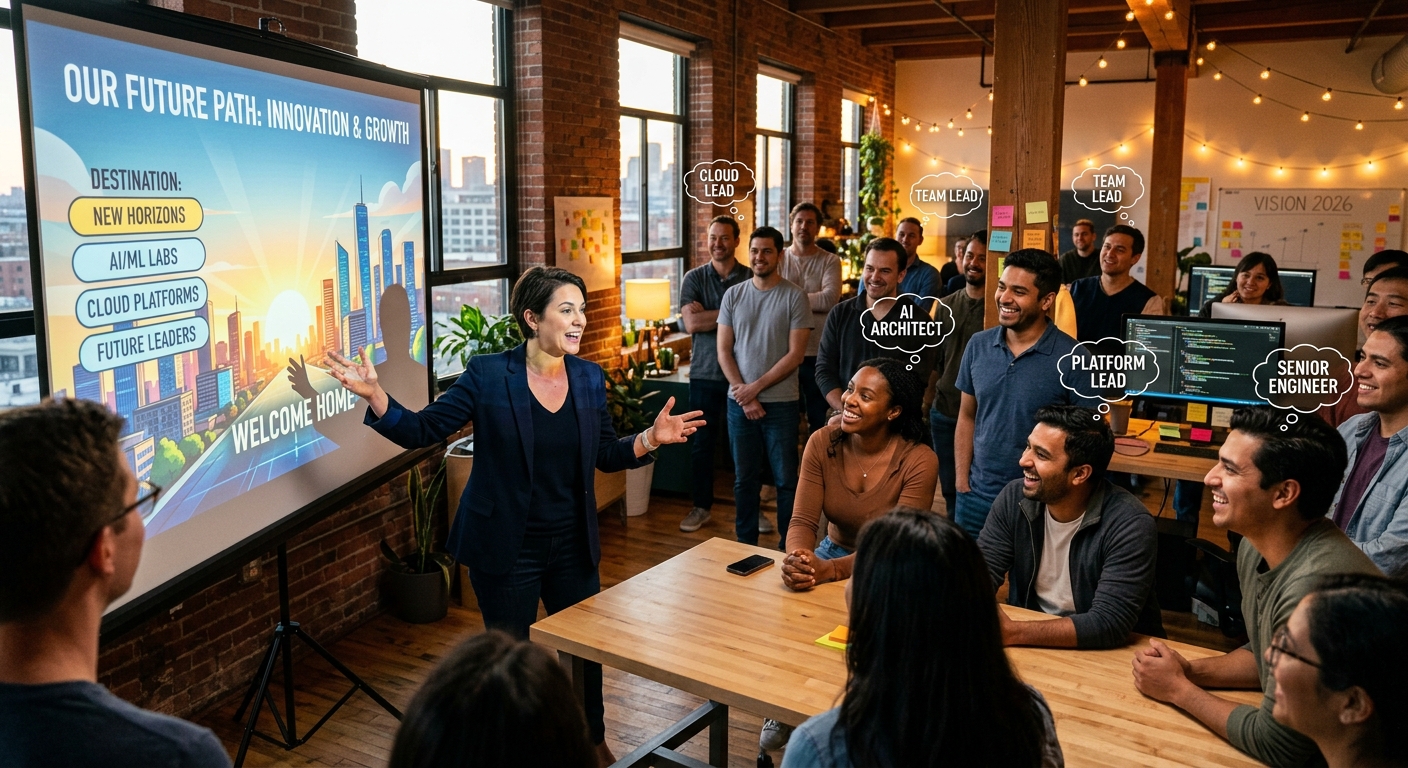
That is the bar. It is higher than most organizations are aiming for.
The AI transformation is uncomfortable. That is not going to change.
The question is whether we can built a conversation that will allow people to feel comfortable to feel uncomfortable.